I'm no Mons Johnson, but I'm going to say it: I really like goblins. I like the goofy, self-destructive, idiot savant medieval-steampunk-mad-scientists who are there for comic relief. I like the noble, misunderstood humanoid race facing ostracization because they've been labelled "evil." Hell, I even like the sexy little green women that seem to have been popularized by World of Warcraft. So imagine my disappointment, then, when they turned out to be such a bust in Dungeons & Dragons.
The thing is, goblins weren't really meant for player use, and it shows. While they have a +0 level adjustment, which is probably to be expected, their statblock also notes that "goblins with levels in NPC classes have a CR equal to their character level -2" (as opposed to the usual NPC's -1.) So really they're intended to be evil but weak little foes with some character levels that might be familiar. A level 3 goblin warrior or adept will have a CR of 1, but don't expect to play a level 3 goblin adept and have it count as a level 1 character.
I'm going to go off on a brief tangent here and lament the fact that goblins perhaps had the problem of not quite being bad enough. I mean, they come up a little short as far as player character races go, but it's not by a lot. Consider the kobold, however: another weak, evil 'NPC race,' the kobold is probably inferior to even the goblin, with its stat modifiers providing an overall net loss of -4. They were seen as so weak that Wizards stepped in and provided plenty of support material for them, from an entire chapter in Races of the Dragon that provided all sorts of kobold-specific feats and alternate class features, to a tailor-made web enhancement article that just threw in four more racial traits for free, not to mention a feat that increases your goddamn caster level. Most discussion of kobolds nowadays centers around how overpowered they often are in practice, with the poorly-thought-out Dragonwrought feat and various spellcasting boosts made available to kobolds alone. This is, of course, in addition to the various subraces printed since then that allow for superior stat modifiers depending on your build. There are no doubt a number of players who are blissfully unaware of the fact that the kobold was ever seen as a weak point in need of shoring up. See what I mean? The kobold is so weak that the squeaky wheel gets the grease, whereas the long-suffering goblin is just decent enough that it can be completely ignored in a system that prints books at the drop of a hat.
Wednesday, May 30, 2018

Tuesday, April 3, 2018
Battle Jump
If it hasn't already been made abundantly clear, you can do some pretty silly things thanks to the Book of Nine Swords. Really it has no shortage of silliness within its very pages, but sometimes you can get a really spiffy effect by combining the new offerings for marshal adepts with an abusable piece of minutae from a previous splatbook.
Saturday, March 3, 2018
Mirror Move
In D&D, it can be tempting to try and do everything. You want to have all these spells, and these prestige classes, and these feats, and even these various skill ranks... yes, it can be tricky to fit everything that catches your eyes into a single build. But what if you were able to sub in what you want when you want it now and then? You might not be able to trade out class levels on the fly, but whenever you see someone using a cool feat, do you not think to yourself "I wish I could try that"?
Well if you're willing to look way back to a dubious little corner of an unofficial web article, you just might be able to try that.
Mirror move is a 2nd level bard/wizard spell that allows you to make like Taskmaster and copy any physically demonstrable feat that you see. If you're wondering why you haven't seen nor heard of this admittedly funky spell, it's because it's from a somewhat dubious source - a web article published in 2001 that was never subsequently included in a book, updated for 3.5, or otherwise mentioned again. Yes, the same source as guidance of the avatar and other suspect tidbits. Still, it was published by Wizards, so if your DM doesn't mind you can have some fun with this one.
If it wasn't obvious already, I have a deep love for open-ended feats and spells. Having a single option that can be tooled to the current situation rewards creativity and inventiveness without demanding perfect foresight or having an overabundance of niche options prepared "just in case." After all, you can rarely be certain of what you'll come across in any given day of your adventuring career, let alone while adventuring in general, so having a multi-tool can keep you from being caught with your pants down. Unlike a lot of the usual "cast this and pick what you want" sorts of spells, though, mirror move functions a little differently.
Well if you're willing to look way back to a dubious little corner of an unofficial web article, you just might be able to try that.
Mirror move is a 2nd level bard/wizard spell that allows you to make like Taskmaster and copy any physically demonstrable feat that you see. If you're wondering why you haven't seen nor heard of this admittedly funky spell, it's because it's from a somewhat dubious source - a web article published in 2001 that was never subsequently included in a book, updated for 3.5, or otherwise mentioned again. Yes, the same source as guidance of the avatar and other suspect tidbits. Still, it was published by Wizards, so if your DM doesn't mind you can have some fun with this one.
If it wasn't obvious already, I have a deep love for open-ended feats and spells. Having a single option that can be tooled to the current situation rewards creativity and inventiveness without demanding perfect foresight or having an overabundance of niche options prepared "just in case." After all, you can rarely be certain of what you'll come across in any given day of your adventuring career, let alone while adventuring in general, so having a multi-tool can keep you from being caught with your pants down. Unlike a lot of the usual "cast this and pick what you want" sorts of spells, though, mirror move functions a little differently.
Wednesday, February 28, 2018
Firepower
Not all things are created equal, a tacit fact that is again and again reinforced by the mechanics of Dungeons & Dragons. The fighter can never hope to keep up with the wizard as levels ramp up, and everything a monk can do a swordsage can do better. Even in less fundamental aspects of the game, this can creep in: just ask any melee character who has tried to use a sword and shield versus a two-handed weapon. Indeed, even something as seemingly flavourful as energy types suffer from this. Don't believe me? Compare how many monsters resist sonic damage versus those that resist fire.
At the top of this pyramid of supremacy, force damage is the way and the path. Essentially nothing resists or is immune to force damage, asides from the (very epic-level) force dragon. A few spells and items make a particular call-out for magic missile spells. Next there is the second-tier of energy types: unusual call-outs like holy damage (a la flame strike,) and desiccation damage (a la desiccate.) Very rarely are these going to be resisted or affected in any way: they're virtually "typeless" the way force damage often is. That said, they're also very uncommon. Third tier belongs to sonic damage, which is the most effective of the "core" energy types. Fourth tier holds acid and electricity, in that order, and the bottom tier holds cold damage and lastly fire.
This hierarchy is in no way official or rigid: it's just a vague guideline I've determined from observation. It simply means that putting aside the setting, environment or pre-established foes, if you prepare an acid spell instead of an otherwise-identical fire spell, you're less likely to run across a foe who will be resistant or immune to it. 3d6 acid damage isn't "better" than 3d6 fire damage, there have just been more creatures with fire resistance that have been printed. Demons, devils, dragons, celestials: all the major players shrug off the effects of fire.
So why the imbalance? Is this just another matter of "X is better than Y, get over it"? Well... sort of. The thing is, the greater reliability of the higher-tier energy types often comes with an arbitrary balancing factor. This is perhaps best demonstrated in the orb of X line of spells. Orb of fire deals 1d6 fire damage per level (maximum 15d6) and makes the target save against dazing. Each orb has a different riding effect, though, so the orbs with a slightly better damage have slightly worse effects. For instance, orb of cold forces a save against blinding (not as impressive) and orb of acid a save against being sickened (a comparatively minor hindrance indeed.) Then you get to orb of sound, which can deafen the target (ho-hum) and deals only 1d4 damage per level. The fact it's dealing sonic damage is reason enough to lower the damage dice. Then lastly, there's orb of force, which has no secondary effect and tops out at a maximum of 10d6 damage, rather than 15.
So there isn't really an inherent pros-and-cons debate introduced by using force damage over fire damage, say, it's just that in many cases spells and effects will likely be balanced to somewhat favour the "worse" energy types in case-by-case bases. In addition, there are far more feats, class features and items to improve your cold and fire spells (take even a casual glance at Frostburn) than for, say, sonic or desiccation damage. This is an imperfect science, of course, but at least the effort is there.
If we know what energy types are "best" and which are "worst" (yet have the best spells,) what do we do with this knowledge? Well, fire damage may be much-maligned in general for its generally underperforming against a variety of enemies, but its humble status as the lowliest energy type has earned it the most published support. If all of this support material exists mostly to balance it out against the other types, though, why bother? Well, it would suddenly get a lot more impressive (and hey, interesting for roleplaying) if those shortcomings could be easily undone, wouldn't it?
Enter Searing Spell.
This little gem from Sandstorm does something very unusual - it makes your fire spells so supernaturally hot that they ignore all fire resistance and even still do half damage to creatures with fire immunity. What do you want to bet that a fire elemental has never felt what it's like to be burned before? As a nice bonus, a searing spell also does double damage to creatures with the cold subtype - which is on top of the double damage they were already taking from a fire spell. This peace of mind comes at the acceptable cost of a spell slot one level higher.
So now you can fling fire spells around with little worry for targeting restrictions. Sure, Energy Substitution already existed and doesn't even raise the spell's level, but what if you want to stick to fire spells thematically? A pyromaniac shouldn't have to shoot "coldballs" just because he's facing an efreet. More importantly, it's generally the case that if a monster has resistance to one energy type, it does to most of them, especially with Outsiders and at higher levels. It's also the case that changing the energy types of your spells won't let you reliably capitalize on its original energy type - something that can be very handy, as we're about to see.
So removing the biggest downside of fire damage is a real coup, but pumping the cost of all of your spells by one level is a pretty hefty cost. Is there enough support for fire damage that can make it worthwhile? Unshockingly, the answer is... perhaps!
At the top of this pyramid of supremacy, force damage is the way and the path. Essentially nothing resists or is immune to force damage, asides from the (very epic-level) force dragon. A few spells and items make a particular call-out for magic missile spells. Next there is the second-tier of energy types: unusual call-outs like holy damage (a la flame strike,) and desiccation damage (a la desiccate.) Very rarely are these going to be resisted or affected in any way: they're virtually "typeless" the way force damage often is. That said, they're also very uncommon. Third tier belongs to sonic damage, which is the most effective of the "core" energy types. Fourth tier holds acid and electricity, in that order, and the bottom tier holds cold damage and lastly fire.
This hierarchy is in no way official or rigid: it's just a vague guideline I've determined from observation. It simply means that putting aside the setting, environment or pre-established foes, if you prepare an acid spell instead of an otherwise-identical fire spell, you're less likely to run across a foe who will be resistant or immune to it. 3d6 acid damage isn't "better" than 3d6 fire damage, there have just been more creatures with fire resistance that have been printed. Demons, devils, dragons, celestials: all the major players shrug off the effects of fire.
So why the imbalance? Is this just another matter of "X is better than Y, get over it"? Well... sort of. The thing is, the greater reliability of the higher-tier energy types often comes with an arbitrary balancing factor. This is perhaps best demonstrated in the orb of X line of spells. Orb of fire deals 1d6 fire damage per level (maximum 15d6) and makes the target save against dazing. Each orb has a different riding effect, though, so the orbs with a slightly better damage have slightly worse effects. For instance, orb of cold forces a save against blinding (not as impressive) and orb of acid a save against being sickened (a comparatively minor hindrance indeed.) Then you get to orb of sound, which can deafen the target (ho-hum) and deals only 1d4 damage per level. The fact it's dealing sonic damage is reason enough to lower the damage dice. Then lastly, there's orb of force, which has no secondary effect and tops out at a maximum of 10d6 damage, rather than 15.
So there isn't really an inherent pros-and-cons debate introduced by using force damage over fire damage, say, it's just that in many cases spells and effects will likely be balanced to somewhat favour the "worse" energy types in case-by-case bases. In addition, there are far more feats, class features and items to improve your cold and fire spells (take even a casual glance at Frostburn) than for, say, sonic or desiccation damage. This is an imperfect science, of course, but at least the effort is there.
If we know what energy types are "best" and which are "worst" (yet have the best spells,) what do we do with this knowledge? Well, fire damage may be much-maligned in general for its generally underperforming against a variety of enemies, but its humble status as the lowliest energy type has earned it the most published support. If all of this support material exists mostly to balance it out against the other types, though, why bother? Well, it would suddenly get a lot more impressive (and hey, interesting for roleplaying) if those shortcomings could be easily undone, wouldn't it?
Enter Searing Spell.
This little gem from Sandstorm does something very unusual - it makes your fire spells so supernaturally hot that they ignore all fire resistance and even still do half damage to creatures with fire immunity. What do you want to bet that a fire elemental has never felt what it's like to be burned before? As a nice bonus, a searing spell also does double damage to creatures with the cold subtype - which is on top of the double damage they were already taking from a fire spell. This peace of mind comes at the acceptable cost of a spell slot one level higher.
So now you can fling fire spells around with little worry for targeting restrictions. Sure, Energy Substitution already existed and doesn't even raise the spell's level, but what if you want to stick to fire spells thematically? A pyromaniac shouldn't have to shoot "coldballs" just because he's facing an efreet. More importantly, it's generally the case that if a monster has resistance to one energy type, it does to most of them, especially with Outsiders and at higher levels. It's also the case that changing the energy types of your spells won't let you reliably capitalize on its original energy type - something that can be very handy, as we're about to see.
So removing the biggest downside of fire damage is a real coup, but pumping the cost of all of your spells by one level is a pretty hefty cost. Is there enough support for fire damage that can make it worthwhile? Unshockingly, the answer is... perhaps!
Sunday, December 10, 2017
Animate with the Spirit
Undeath is a pretty fun well to dip into, so long as you aren't actually drinking from it.
The thing is, it's a tricky and contentious brand of magic. The last couple of articles might have gotten you interested, but of course, it's not like just anyone can cast animate dead. (Sorry sword-swingers, before you get too excited, I'm not about to reveal a way for you to reanimate undead minions.) Animate dead is only for wizards and clerics, and worse still, the moral implications of even using such a spell are... suspect, at best. Being a heroic fantasy game, D&D characters are generally going to be good, and it can be hard to justify reanimating corpses with negative energy as a result. The problem is, naughty necromancers don't get any love from Santa come Christmastime. So how do capital-G-Good characters get in on the fun? And in the spirit of the season, can't rangers, druids and paladins also get a present while we're at it?
The thing is, it's a tricky and contentious brand of magic. The last couple of articles might have gotten you interested, but of course, it's not like just anyone can cast animate dead. (Sorry sword-swingers, before you get too excited, I'm not about to reveal a way for you to reanimate undead minions.) Animate dead is only for wizards and clerics, and worse still, the moral implications of even using such a spell are... suspect, at best. Being a heroic fantasy game, D&D characters are generally going to be good, and it can be hard to justify reanimating corpses with negative energy as a result. The problem is, naughty necromancers don't get any love from Santa come Christmastime. So how do capital-G-Good characters get in on the fun? And in the spirit of the season, can't rangers, druids and paladins also get a present while we're at it?
Sunday, November 19, 2017
On the Proper Care and Maintenance of Undead
We can all take solace in the common struggle that we as human all face: we just want someone to boss around. That's probably a big draw for the fantasy escapism of D&D, but astonishingly even therein it's easier said than done. Pelor knows your party's an ornery bunch, and they'd rather shake down commoners for copper pieces than do anything you suggest. The Leadership feat is banned in some campaigns, and you have to be careful with your followers lest they become disenfranchised. Most campaigns don't run psionics (for you wannabe thrallherds out there) and planar binding can be a real hassle with all of the costs, exacting rules and opposed charisma checks. What's a power-hungry lunatic to do?
Fortunately, for any problem, we have undead. Order them around, use them for combat, hard labour, hat racks, you name it. They don't complain or disobey, and best of all, you don't even have to feed them. Ah, the wonders of magic. One casting of animate dead and you've got a contingent of skeletons ready to either kick ass or kiss ass, at your option.
 ...not that it's without its deficiencies, however. Having no intelligence or self-sufficiency feel like par for the course; I'm referring more to the fact that animate dead can get damned expensive, at 25 gp per hit die. One Turn Undead from an enemy cleric and that's all of your money and hard work wasted. Plus, there is a limit to how many you can command - 4 HD per level may sound like a lot, but the low hit points, saves and BAB of undead mean that most of the worthwhile options need HD as high as possible to make a dent.
So how can you ensure a reanimated legion is worthwhile? A gang of bloodthirsty corpses can pull apart most commoners with ease, but you're going to have to put in a little more effort than that if you hope to pit them against level-appropriate threats. Here, then, I have a short treatise on what corpses to aim for when reanimating, and how to best make use of them once they're active.
Fortunately, for any problem, we have undead. Order them around, use them for combat, hard labour, hat racks, you name it. They don't complain or disobey, and best of all, you don't even have to feed them. Ah, the wonders of magic. One casting of animate dead and you've got a contingent of skeletons ready to either kick ass or kiss ass, at your option.
 ...not that it's without its deficiencies, however. Having no intelligence or self-sufficiency feel like par for the course; I'm referring more to the fact that animate dead can get damned expensive, at 25 gp per hit die. One Turn Undead from an enemy cleric and that's all of your money and hard work wasted. Plus, there is a limit to how many you can command - 4 HD per level may sound like a lot, but the low hit points, saves and BAB of undead mean that most of the worthwhile options need HD as high as possible to make a dent.
So how can you ensure a reanimated legion is worthwhile? A gang of bloodthirsty corpses can pull apart most commoners with ease, but you're going to have to put in a little more effort than that if you hope to pit them against level-appropriate threats. Here, then, I have a short treatise on what corpses to aim for when reanimating, and how to best make use of them once they're active.
Sunday, October 8, 2017
Haunt Shift
Halloween draws near, dear readers, and with it comes all manner of ghosts n' goblins. And ghouls and ghasts and goristros and gorillons and... uh, well, you get the picture. So with all of the restless spirits coming to roost, why not embrace the season and get in on a bit of the haunting yourself?
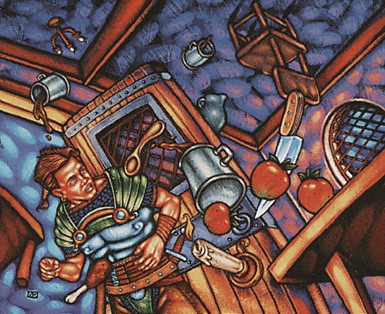
Necromancers have always been able to order around undead armies and generally bend entities of negative energy to their whims. But why settle for undeath by proxy? D12 hit dice and a list of immunities longer than your arm sounds like a good time for any spellcaster, but of course, trading in your meat bag for another, more gangrenous meatbag with an abysmal Fortitude save has its own disadvantages. Really, there's no reason to trifle with bodies at all - once you've crossed that hurdle into undeath, a mid-level spellcaster can make themselves a haunting presence, and go around possessing one item, Poltergeist-style. Of course, you're not just going to pick any Tom, Dick or grand piano off the street: if you get to possess an object and pilot it around, you might as well custom-make the best you can get.

Necromancers have always been able to order around undead armies and generally bend entities of negative energy to their whims. But why settle for undeath by proxy? D12 hit dice and a list of immunities longer than your arm sounds like a good time for any spellcaster, but of course, trading in your meat bag for another, more gangrenous meatbag with an abysmal Fortitude save has its own disadvantages. Really, there's no reason to trifle with bodies at all - once you've crossed that hurdle into undeath, a mid-level spellcaster can make themselves a haunting presence, and go around possessing one item, Poltergeist-style. Of course, you're not just going to pick any Tom, Dick or grand piano off the street: if you get to possess an object and pilot it around, you might as well custom-make the best you can get.
Subscribe to:
Posts (Atom)